|

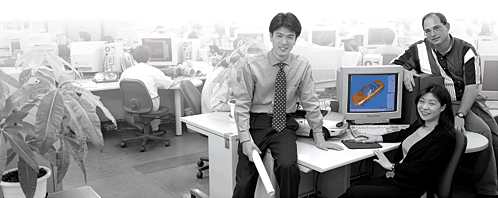
Mazda's ultimate target is aimed at achieving an interval between design approval and the initial production of a new model of less than 15 months. In the auto industry, where user expectations are so diverse and change so rapidly, that's a tall order. Mazda continues to meet this challenge head-on with the firm intention of achieving recognition as one of the most nimble and responsive automobile manufacturers in the world.
toward Phase II Implementation of the advanced MDI system.
The complex challenge of seeking superior levels of efficiency in vehicle development and production processes is heightened by the manufacturer's responsibility to ensure that products are as environment-friendly and safe as possible. We believe that further improvement of mass-produced engines will have the largest impact on the environment and are making continuous efforts in this area. Mazda has developed and marketed the Miller Cycle engine and D-burn (diluted burn) engine. During fiscal 1998, Mazda developed a new three-way catalyst for gasoline engines with improved capability to purify pollutants in exhaust emissions. Mazda has also advanced direct-injection technology in both gasoline engines and diesel engines and launched models equipped with direct-injection turbo diesel engines in Summer 1998. Another focus is the continuing development of a fuel-cell electric vehicle (FCEV), which was exhibited in a Demio model at "Eco-Japan '97" last December. The FCEV generates electricity through an electrochemical reaction between hydrogen and oxygen and produces no CO2 or NOx emissions. In April 1998, Mazda joined a new alliance with Ford, Daimler-Benz and Ballard Power Systems aimed at commercial production of fuel cells and fuel-cell-powered drivetrains in the beginning of the 21st century. Mazda issued a "Voluntary Action Plan for Recycling Promotion" in February 1998 targeting the improvement of the recyclability of new vehicles, with a view to achieving a recyclable rate of over 90% for new models introduced after 2002. The new guidelines include the nationwide collection of scrap bumpers in Japan from Spring 2000; a halving of lead usage in vehicles, excluding batteries, compared to 1996 levels, beginning with new models introduced after the end of 2000; and the introduction of a new onboard system designed to activate unused airbags before recycling, starting with new models introduced after 1999.
|
Swift Response  Global Efficiency
Capturing Hearts
Global Efficiency
Capturing Hearts
|