|
 |
|
 |
|
 |
|
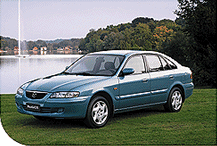
| The new 626 series was introduced in Asia, Oceania, the Middle East and other regions as one of the core models in Mazda's product lineup. The 626 is highly regarded for its quality and value. |
|
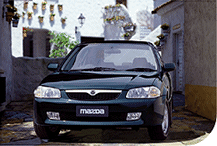
AAT started production of the new 323 in Thailand in Janualy 2000. The 323, as the second production model at AAT, will strengthen the Mazda brand there. |
|
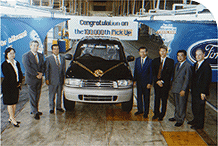
In August 2000, the cumulative production of B-series pickup trucks at AAT exceeded 100,000 units. B-series models have been well received in the local market and are also exported to more than 80 countries, excluding North America and Japan. |
|
In Asia, Mazda retail sales increased 34.3% to nearly 32,000 units, due to overall economic recovery, reorganization measures, strengthening of dealerships in major countries, and aggressive sales programs. As a result, we achieved significant sales growth, particularly in Thailand and Taiwan.
In Thailand, industry new vehicle retail sales soared 70.3% to almost 237,000 units. During the fiscal year AAT began production of the 323 for the local market in January 2000. ATT-built B-series pickup trucks are well received not only in Thailand but also in export markets such as Europe, Australia, New Zealand and other countries. With the addition of 323 production, AAT has started full-capacity level operations.
In July 1999, Mazda acquired a majority share of our Thailand distributor, Sukosol and Mazda Co., Ltd. (SMC) and renamed the company Mazda Sales (Thailand) Co., Ltd. (MST). In line with other structural changes, Mazda consigned a part of MST's operations to Ford, including sharing its backroom facilities in July 1999, to improve management efficiency. Mazda also reinforced the dealer network and rebuilt sales capacity in line with the expansion of the market.
Mazda's retail sales in Taiwan increased 118.9% to nearly 8,000 units with a new distributor, upgrade of dealer sales capacity, and successful implementation of the “One Operation” program with Ford. New model introductions and enhancements to the Mazda brand were other contributing factors.
In Oceania, Mazda retail sales dropped 2.9% to approximately 30,000 units. In Australia, despite the introduction of new models, retail sales decreased 2.1% to around 2,600 units amid stiff competition. Mazda's market share, however, increased 0.1 percentage points to 3.4%. In New Zealand, retail sales decreased 2% to almost 3,000 units due to fierce price competition in the market and a readjustment among dealers brought about by the reorganization of sales channels in Auckland.
In the Middle East, total retail sales decreased 20.8% to approximately 33,000 units. In Israel, retail sales jumped 24.8%, with Mazda maintaining the largest market share among auto manufacturers for the fourth consecutive year. Strong sales of the 323 and increases in fleet sales supported this positive performance.
In Africa, retail sales increased 1.9% to around 44,000 units. In Zimbabwe, a major market for Mazda in the region, retail sales dropped 46.6% to nearly 3,000 units, due primarily to a weakened local currency and shortage of foreign currency reserves.
Industry demand in Latin America remained stagnant during the year as Brazil's economic downturn continued. In July 1999, Mazda and Ford strengthened a strategic alliance in Colombia and Venezuela, striving for optimal synergies in manufacturing and distribution operations for each company's brand models. In July 1999, Compaña Colombiana Automotriz S.A. (CCA), the assembly base of Mazda brand vehicles in Colombia, began production of a Ford model to be distributed by Ford in the region. Ford of Venezuela, in turn, produces Mazda B-Series pickup trucks distributed by Vehiculos Mazda de Venezuela C.A. Mazda Argentina, a distributor of Mazda brand vehicles, was established as a division of Ford Argentina S.A. in June 2000. Mazda Argentina will focus on expanding its sales network to build upon its customer base in the region. |
|