

|
|
 |
|
| Quality craftsmanship and teamwork promote greater productivity and higher capacity in the entire manufacturing process. |
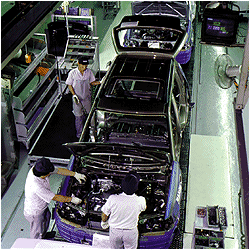
 One of the leading pioneers in manufacturing, technical and engineering skills in the industry, Mazda is renowned for our high manufacturing quality. In terms of our Worldwide Brand Positioning, the objective of Mazda's manufacturing technologies is to establish an efficient manufacturing system to quickly meet the diversifying needs of today's customers in various regions of the world by realizing agile and small lot manufacturing systems
at our plants.
One of the leading pioneers in manufacturing, technical and engineering skills in the industry, Mazda is renowned for our high manufacturing quality. In terms of our Worldwide Brand Positioning, the objective of Mazda's manufacturing technologies is to establish an efficient manufacturing system to quickly meet the diversifying needs of today's customers in various regions of the world by realizing agile and small lot manufacturing systems
at our plants.
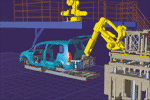
To carry through this objective, progress achieved under MDI significantly contributes to the superior product quality of our vehicles, as well as enhancement in efficiency, by using the 3D approach in more areas and advance verification through simulation. Through Digital Factory, functional analysis in the MDI process, prior to actual production, manufacturing operations such as machining and assembling are implemented through computer simulation to review their suitability, parts interference and ease of assembly. Such virtual simulations of the manufacturing process now play an indispensable role with regards to quality assurance, manufacturing efficiency and agile and small lot manufacturing systems.
To assure "Superior Handling," an important product attribute for the brand strategy, the MDI process serves as an indispensable tool. For example, to attain best optimum wheel alignments, the 3D approach reveals factors that contribute to achieving objective target levels and their interrelationship encompassing design, engineering and manufacturing functions.
 Another contributory factor of Mazda's advancement in manufacturing technology is the Circulated Body Assembly Line (C-BAL), a mixed body assembly line producing different models in varying volumes.
The C-BAL line is a versatile body assembly line utilizing carts fitted with jigs for each specific body type that enables the production of up to twelve different models as well as changeovers without lengthy interruptions. Mazda was the very first auto manufacturer in the world to introduce such a line. The C-BAL has also contributed to agile and small lot production in addition to a remarkable reduction in the lead times for mass production. The line was first introduced in our Hofu Plant in 1992, with an upgraded version subsequently used thereafter in operations in our Hiroshima Plant.
Another contributory factor of Mazda's advancement in manufacturing technology is the Circulated Body Assembly Line (C-BAL), a mixed body assembly line producing different models in varying volumes.
The C-BAL line is a versatile body assembly line utilizing carts fitted with jigs for each specific body type that enables the production of up to twelve different models as well as changeovers without lengthy interruptions. Mazda was the very first auto manufacturer in the world to introduce such a line. The C-BAL has also contributed to agile and small lot production in addition to a remarkable reduction in the lead times for mass production. The line was first introduced in our Hofu Plant in 1992, with an upgraded version subsequently used thereafter in operations in our Hiroshima Plant.
Our metal mold technology has also significantly supported implementation of Mazda's new "Contrast in Harmony" design theme in production. To realize the edge and curves designed in our newly launched Premacy and MPV models, a vast amount of metal mold-making expertise is incorporated with state-of-the-art information technology. In effect, the people at Mazda are integrating their accumulated skills and craftsmanship to combine human ingenuity with digital precision in a cost-efficient manner.
Mazda promotes Total Productive Maintenance (TPM) activities throughout our plants. The objective of TPM is to obtain the maximum efficiency of our manufacturing facilities, which ultimately assures the quality of our products. Starting with the cleaning of the workplace, plant workers have aimed at zero-accidents, zero-defaults and zero-fault operations of equipment by continuously exchanging ideas and suggestions to raise capabilities in facilities and the entire manufacturing process. As a result, TPM has enabled adjustments in fluctuations of production volumes and reduced production costs by approximately 30%.
One of the priority issues for Mazda in the coming century is to build a proficient manufacturing capability for respective global markets. In achieving this objective, the development of a long-term Product Cycle Plan coordinated between Mazda and Ford will play an important role. The first outcome of this plan will be implemented in late 2000 with the production of a sports utility vehicle, the right-hand drive version of which will be produced at our Hofu Plant. Such measures are expected to improve the synergistic effects and capacity of Mazda and Ford manufacturing facilities on a global scale.
 |
|
 |
|
 |
|
  |
 |
 |
 |