 |
 |
|
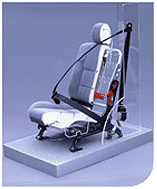 |
| The newly developed Safety Active Seat reduces the risk of neck injuries resulting from sear-end collisions | |
|
| Future Direction for Mazda Vehicles |
At motor shows in Tokyo, Detroit and Geneva, Mazda presented the future direction for Mazda vehicles along with technology exhibits related to environmental and safety topics.
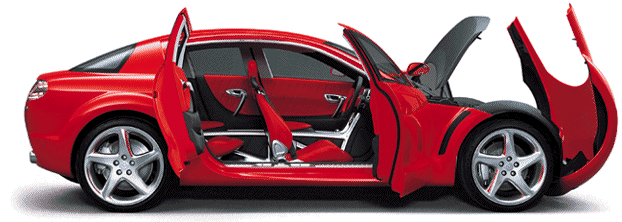
Mazda presented RX-EVOLV, which received wide public acclaim in these motor shows. The sleek RX-EVOLV, with a 4-door and 4-seat configuration, promises to be a new genre of sports car. The RX-EVOLV incorporates elements that we believe embody the fundamental essence of a sport car: an optimized lean and muscular body, a consistent application of thorough weight reduction, a balanced 50-50 front-rear weight distribution and a rear-wheel-drive layout. The RX-EVOLV is equipped with the compact RENESIS rotary engine, developed based on Mazda's long-standing legacy of rotary engine technology. Naturally aspirated, the RENESIS produces exceptionally high power, 280 PS, revs freely and smoothly to 10,000 rpm and meets Japan s stringent LEV (low emission vehicle) standards in order to respond to environmental requirements. We believe RX-EVOLV is more than capable of transporting Mazda's sports car heritage into the new millennium. In this respect, we are studying the possibility of a new generation of sports cars based on this concept model.
|
Mazda presented the Safety Active Seat and Smart Airbag as part of a technology exhibit on safety-related issues. The Safety Active Seat uses a new technology to reduce whiplash injury. In a rear collision, the headrest moves forward quickly to support the head of the passenger. This reduces sharp movement of the neck immediately after a collision, greatly reducing the stress to this region of the body. Moreover, the Safety Active Seat uses a seatbelt system that predicts rear-end collisions before they occur and then firmly restrains a passenger's body.
The Smart Airbag uses a two-stage inflator. It monitors collision force and deploys the airbag in two stages in relation to the impact force. In low-speed collisions, inflation of the air bag is 30 percent less than that applied during high-speed collisions, reducing the impact force on passengers. |
|
|
 |
|
| The RX-EVOLV continues the legacy of Mazda's rotary engine technologies and epitomizes Mazda's Dynamic DNA. |
|
|
| Environmental Issues |
Mazda has made numerous improvements to existing engines, including direct injection of gasoline and diesel engines, to minimize their effects on the environment. Alongside these developments, R&D is focusing on developing hybrid vehicles, fuel cell electric vehicles (FCEV) and electric vehicles.
At the October 1999 Tokyo Motor Show, Mazda presented the Demio, Mazda DIREC-G direct fuel injection gasoline engine, Mazda DIREC-D direct fuel injection diesel engine, and the Mazda Toroidal CVT next-generation transmission.
Mazda is also participating in a joint project to develop fuel cell technology through Ford. In this respect, Mazda will participate as a member of the Ford Group in the joint FCEV driving test in Spring 2001 under a program operated in Japan by Daimler-Chrysler Japan Holding and Nisseki Mitsubishi with support from the Ministry of International Trade and Industry and the Agency of Natural Resources and Energy.
In addition, Mazda remains committed to several environmental management projects underway. One example is a recycling project for bumpers. After being launched as a trial program in designated regions, nationwide expansion of this recycling project was completed in November 1999.
Furthermore, an original Mazda-developed technology features an aldehyde capture material that is highly effective in removing aldehyde, a harmful substance to human beings. In fiscal year 2000 and beyond, Mazda applied the agent in cabin air filters used in the Premacy, Demio, 626 and Millenia.
Mazda obtained ISO14001 certification, related to the environmental management system, for the Hofu Plant during the year. Mazda also obtained ISO14001 accreditation for operations in the Hiroshima area, including the Hiroshima Plant and the Miyoshi Plant and Proving Ground in June 2000. These measures were of an unprecedented scale in the Japanese automobile industry.
Mazda has also made substantial progress in eliminating by-products from plant waste. As of the end of 1999, plant waste reclamation levels were reduced by 66% compared to 1990 levels. Ongoing efforts call for a further waste reduction. |
|
|

